


 |


| Lecithin has a broad and narrow sense, the narrow sense of lecithin refers to phosphatidylcholine, broadly speaking, lecithin refers to phospholipids containing phosphatidylcholine including PC, PE, PI (inositol phospholipids, phosphatidylinositol), PS (serine phospholipids, phosphatidylserines) and so on. Phosphatidylcholine is found in the brain, nervous tissue, liver, adrenal glands, and red blood cells, and egg yolks are particularly abundant (about 8%-10%), so it is called lecithin. Lecithin has two isomers, α and β, according to the different position of phosphoric acid and glycerol connection, and the lecithin in nature is α-type. Α carbon position is connected to almost saturated fatty acids, while β position is usually connected to unsaturated fatty acids such as oleic acid, linoleic acid, linolenic acid and arachidonic acid. The nitrogenous organic base in lecithin that combines with phosphate is choline. The beta carbon atom of the glycerol portion of the lecithin molecule is a chiral carbon atom, resulting in two configurations, D-type and L-type. It is the L-type that exists in nature. This product is composed of several parts: phospholipid molecules, unsaturated fatty acids, choline and inositol. Lecithin in its pure form is a water-absorbent white waxy substance, which changes to a yellow or brown translucent waxy mass in air due to the oxidation of unsaturated fatty acids. The lecithin precipitated by acetone is granular or powdery. Soluble in petroleum ether, chloroform, ether, benzene and ethanol, insoluble in acetone, insoluble in water. It is hygroscopic, easily oxidized, and its color gradually becomes darker in the air. Lecithin is hydrolyzed to glycerol, unsaturated fatty acids, choline and phosphoric acid in the human body, in which the phosphoric acid group is hydrophilic and the fatty acid group is lipophilic, and these two groups make lecithin emulsifying. Physiological role of lecithin: constitutes the main component of the cell membrane, can promote cellular absorption of nutrients to eliminate toxic waste. It can assist the absorption of fat-soluble vitamins A, D, E and K and increase the utilization rate of such vitamins by 100%. Supplementation of sufficient lecithin can enhance cellular vitality, strengthen the body's immunity and resistance to disease. Powerful emulsifier, it can make the cholesterol and neutral fat in the blood break down into very small particles to facilitate the absorption and metabolism of tissues, thus preventing the deposition of cholesterol in blood vessels, preventing arteriosclerosis, hypertension and heart disease caused by cholesterol deposition. More typically a compatible molecule, involved in the composition of various lipoproteins. Indispensable for the catalytic action of various lipid-dependent enzymes. Related to the mechanism of action of hormones. It plays an important role in the transmission of nerve excitation. Sun Runguang et al. studied the electrical conductivity of lecithin-porphyrin-like metal complexes (complexes are now called coordination compounds, referred to as complexes). | |||||||||
8002-43-5
bosschemical
8002-43-5
Lecithin
CAS No. 8002-43-5
Alias: Ethanol, l-α-phosphatidylcholine solution;l-α-phosphatidylcholine, hydrogenated;LECITHIN GRANULAR G2C (EPIKURON 100G2C);
Molecular formula:C42H80NO8P
Molecular weight:758.06
Structural formula:
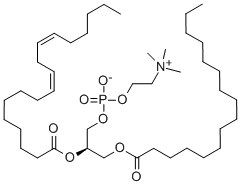
1.Performance and use:
Nutritional medicine. Used for the prevention of atherosclerosis, hypertension, heart disease, Alzheimer's disease, gout, diabetes, neurasthenia. Can also be used for bacterial culture medium preparation. Phospholipids are powerful emulsifiers that can “emulsify” cholesterol and fat into very fine particles, and even dissolve formed “atherosclerotic plaques”, thus lowering blood lipids and reducing the chances of stroke and myocardial infarction. As an emulsifier, phospholipids can also help the body absorb fat-soluble vitamins A, D, E, K, etc., for the body's normal functioning. Note that different preparations have different therapeutic effects. Uses as health food raw materials, emulsifiers, quality improvers, emulsifiers for injection and liposome raw materials can effectively improve and prevent atherosclerosis, hypertension, heart disease and stroke, while enhancing cellular vitality, regulating the nervous system uses biochemical research, the main structure of the brain in the phospholipids. Uses The biggest use of soybean hatching phospholipids is for food additives, the base second is for feed additives. Also used in medicine, cosmetics, and leather, asphalt emulsifier.
2.Technical indicators:
Test Items | Release Standard Limit/Shelf Life Standard Limit |
Inspection Results |
Appearance | White To Off White Powder Or Lump |
White Powder |
Moisture |
Not More Than 2.0% |
1.14% |
Heavy Metal |
Not More Than 10ppm |
Compliance |
Fatty Acid Purity |
Not Less Than 98.0% |
99.14% |
Residual Solvent | Methyl Tert Butyl Ether ≤ 0.5% |
Compliance |
Acetone ≤ 0.5% | Compliance | |
Dichloromethane ≤ 0.06% | Compliance | |
Trichloromethane ≤ 0.006% | Compliance | |
Related Substances | Lysophosphatidylcholine ≤ 0.5% |
Not Detected |
Other Unknown Objects ≤ 0.5% |
Not Detected | |
Free Fatty Acid ≤ 0.3% | Compliance | |
Content | Calculated As Anhydrous Matter, Phosphorus Content Is 3.8% - 4.1% |
3.91% |
Not Less Than 98.0% Based On Anhydrous Matter |
100.05% | |
Bacterial Endotoxin |
Not More Than 60eu/g |
Compliance |
3. Packaging and storage:
Packaging specification: Packing specification: 25kg/bag, also can be determined according to user's need.
During transportation, it is necessary to protect against sunlight, rain, and high temperatures.
The product should be stored in a cool, dark, ventilated place, away from sources of fire.
4.Safety protection:
Pay attention to labor protection when handling it and avoid contact with skin, eyes, etc.After contact, rinse immediately with plenty of water
Related keywords:
Lecithin
CAS No. 8002-43-5


